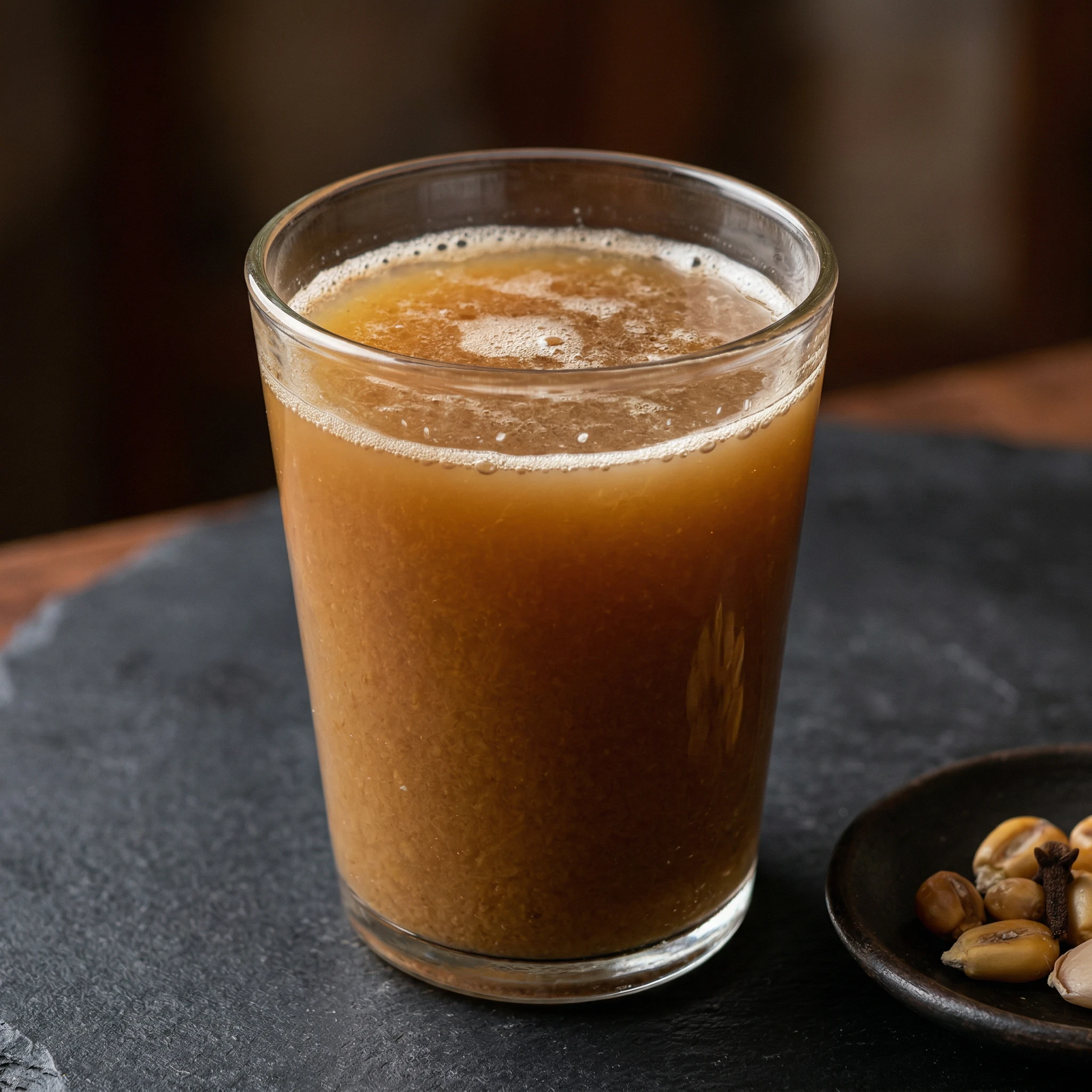
A Cusco picantería-style chicha, lightly foamy and pleasantly tart. Its milky yellow color, gentle body, and fermented grain character preserve the personality of a drink deeply tied to Andean tables, celebrations, and traditions. Cool or at room temperature, it has an unmistakably old-world flavor that begs for Cusco food alongside it.
Turn what you find into an experience you can actually bring to your kitchen.

Set aside roughly one quarter of the water for the second extraction and one tenth for the flour porridge; use the rest in a large pot. Add the jora corn and one fifth of the flour, bring to a boil, then simmer for 75 minutes, stirring occasionally, until the liquid looks milky yellow, smells distinctly of cooked grain, and has developed a light body. This first extraction is the upi.
Strain the upi into a bowl and return the jora solids to the pot. Add the water reserved for this second extraction and simmer for 45 minutes, until the fresh liquid again develops a yellow color and a pronounced corn aroma. Strain once more, discard the solids, and combine both extracts in the cleaned pot.
Whisk the remaining flour with the reserved water until completely smooth, then gradually pour it into the upi while whisking. Add the brown sugar and cook over low heat for 8 minutes, stirring frequently, until the chicha becomes slightly fuller and barely coats the spoon without turning into a porridge. Remove from the heat.
Let the chicha cool for 1 hour, until it reaches room temperature. Transfer it to a very clean glass jar, leaving some headspace, and cover it with a clean cloth rather than sealing it airtight. Ferment it away from direct sunlight for 72 hours. By the end it should smell pleasantly of tart fermented grain, show some light foam or bubbling, and taste less sweet than it did initially. If you see colored mold, detect a rotten odor, or notice a slimy, stringy texture, discard it.
Strain the chicha one final time to remove the coarsest sediment and serve it cool or at room temperature. It should be cloudy, milky yellow, lightly foamy, and brightly tart, while still retaining a gentle corn character underneath. And that's it—the kind of chicha that belongs beside a Cusco table.