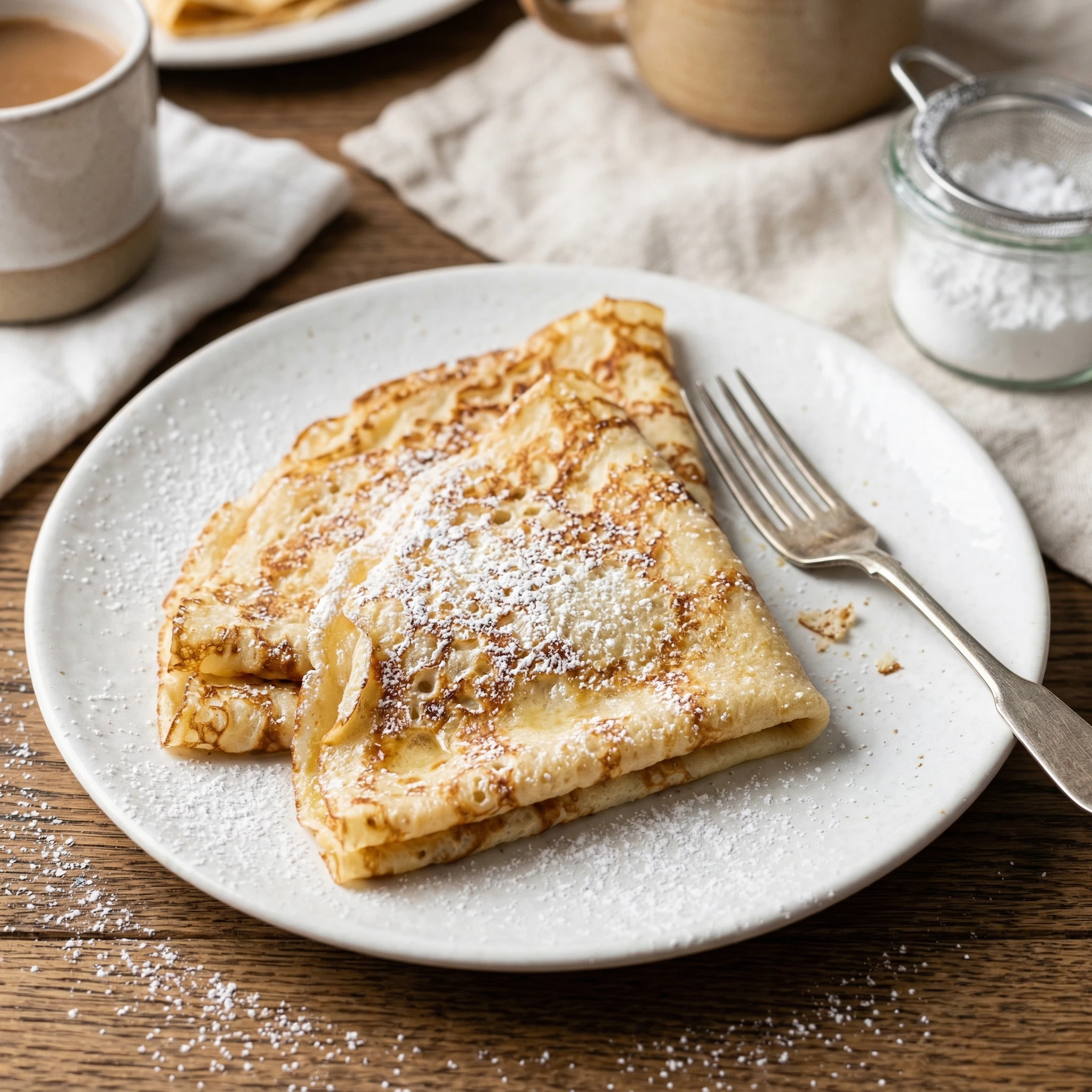
Thin, flexible French crêpes with gentle sweetness, lightly browned edges, and subtle vanilla-butter aroma. Resting hydrates the flour so the batter spreads smoothly without tearing. Served warm with powdered sugar, they work beautifully on their own or with any sweet filling.
Turn what you find into an experience you can actually bring to your kitchen.

Combine the flour, granulated sugar, and salt in a bowl and make a well in the center. In another container, whisk the eggs with roughly one third of the milk until completely blended.
Gradually pour the egg mixture into the flour while whisking from the center outward. Once no dry pockets remain, gradually whisk in the remaining milk, vanilla, and 70% of the butter, melted and only slightly warm. Whisk for about 30 seconds until very fluid, then pass the batter through a fine strainer to remove any lumps.
Cover the batter and let it rest for 30 minutes at room temperature. Whisk briefly afterward to recombine it. It should resemble light cream: fluid enough to run across the pan as soon as it is tilted, yet able to leave a thin, continuous coating.
Heat a roughly 22 cm nonstick skillet over medium heat and brush it with the thinnest film of the remaining 30% of the butter. Pour in about 60 ml of batter and immediately swirl the pan to coat the bottom. Cook for 45–60 seconds, until the surface no longer looks wet, the edges release, and the underside shows golden freckles. Flip and cook the second side for only 15–20 seconds. Repeat to make about 8 crêpes, stacking them so they remain flexible.
Serve the crêpes warm, folded or rolled, and finish with the powdered sugar through a fine strainer. They should feel very thin, soft, and flexible, with golden freckles but no dry edges. If it looks like a pancake, there was too much batter—we are making edible French paper here.