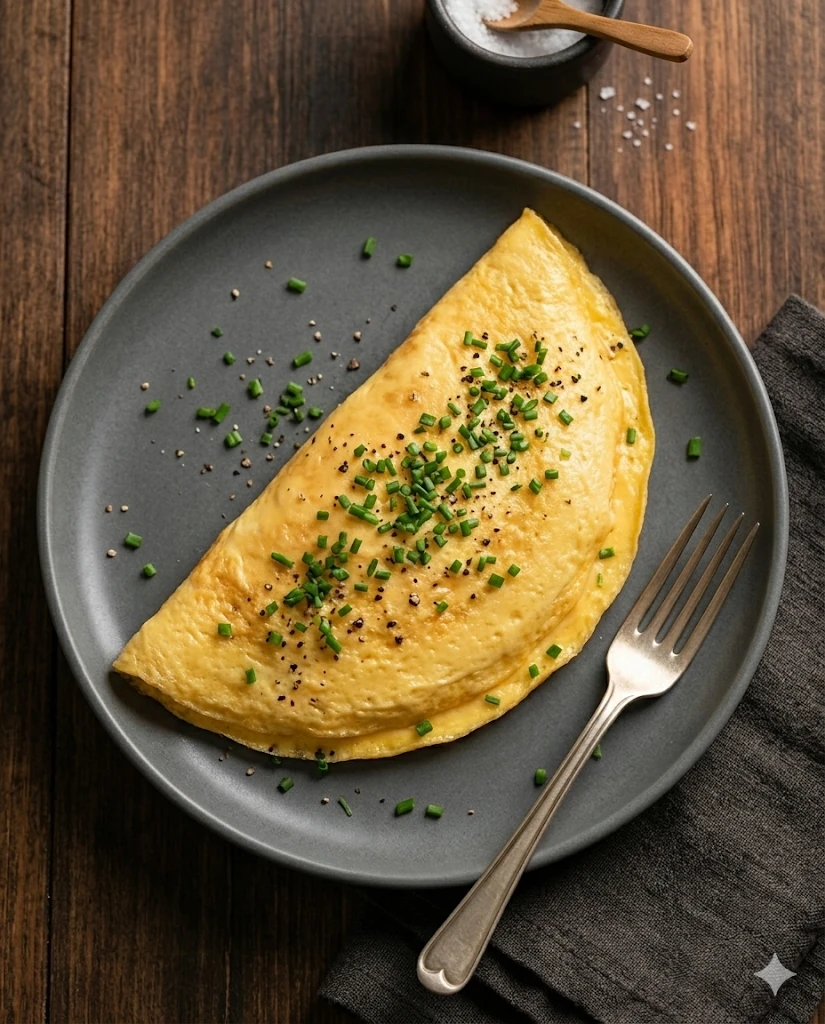
The classic French omelette in its cleanest form: eggs, butter, salt, and pepper. No milk, cheese, or fillings to hide the technique; it should emerge pale yellow and smooth outside, with tiny curds and a still-creamy center. A fundamental breakfast that teaches skillet control in under ten minutes.
Turn what you find into an experience you can actually bring to your kitchen.

Crack the eggs into a bowl, add the salt and black pepper, and whisk for 25 to 30 seconds, moving the whisk from side to side until no long streaks of egg white remain. The mixture should be smooth and uniform; do not add milk or water.
Heat a small nonstick skillet over medium heat. Add the unsalted butter and swirl it over the entire surface. As soon as it is melted and foaming but still yellow, pour in the eggs; if the butter begins to brown, the skillet is too hot for a classic French omelette.
Immediately shake the skillet back and forth while stirring the eggs rapidly and continuously with the spatula, scraping the entire bottom for about 30 to 45 seconds. The goal is very small, tender curds, almost like creamy scrambled eggs. When the mixture has thickened but the surface remains moist and glossy, stop stirring and quickly spread it into an even layer.
With the heat low, loosen the edges and fold roughly one third of the omelette toward the center. Tilt the skillet and fold the opposite side over it to form a short cylinder or closed half-moon. This shaping should take only 20 to 30 seconds: the exterior must remain pale yellow, smooth, and free of browned crust, while the center stays moist.
Slide the omelette onto the plate seam-side down and serve immediately. When cut, the center should be tender and creamy but never liquid, with a smooth surface and no brown patches. If it is dry or browned, it received too much heat; if it is soft and almost satin-like, you have understood one of breakfast's fundamental techniques. Three eggs, butter, and control. Nothing else. 🍳