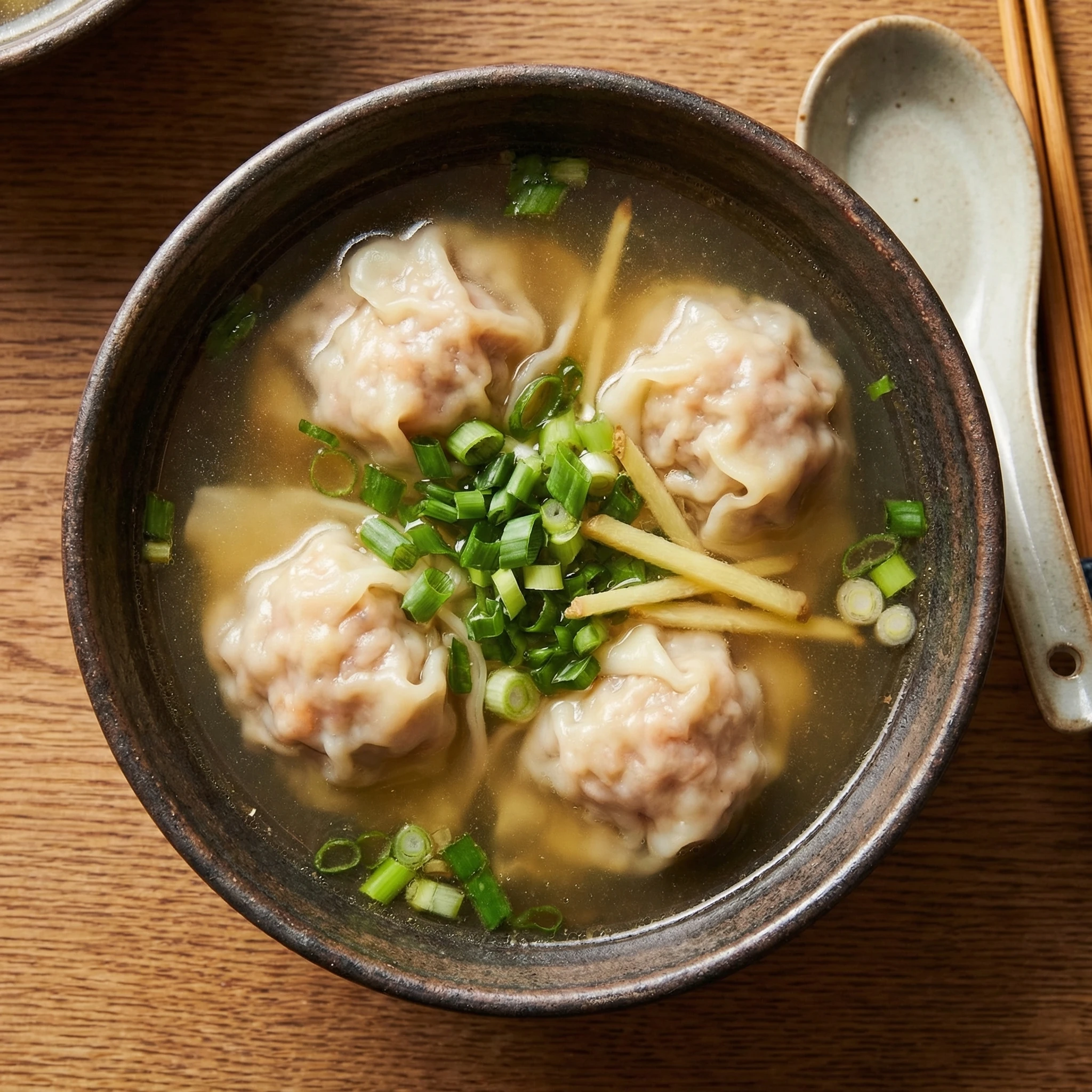
A Peruvian-Chinese chifa soup built around a clear chicken broth, plump pork-and-shrimp sui kao, Chinese noodles, and barely cooked cabbage. Ginger keeps the bowl warm and aromatic while sesame appears only at the finish. It arrives steaming, disappears quickly, and leaves exactly the kind of craving that makes another round sound good before the broth is even gone.
Turn what you find into an experience you can actually bring to your kitchen.

Place the chicken carcasses in a large pot with almost all of the water, three fifths of the ginger, one quarter of the scallions, and two fifths of the salt. Bring to a boil, skim off any foam, then immediately reduce to a gentle simmer. Cook for 40 minutes with the pot partially covered; the broth should simmer quietly rather than boil aggressively.
While the broth cooks, chop the shrimp into small pieces and combine them with the ground pork, soy sauce, three fifths of the sesame oil, all of the cornstarch, the white pepper, one fifth of the finely grated ginger, one quarter of the chopped scallions, and three tenths of the salt. Stir in one direction for 1 minute, until the filling looks tacky and cohesive rather than loose.
Lay out the wonton wrappers and divide the filling to make about 16 sui kao. Lightly moisten the edges with the remaining water, fold each wrapper over the filling, and press from the center outward to push out trapped air before sealing. Keep the dumplings separated and covered as you finish the batch; dry seals and trapped air are what most often make them open in the soup.
Strain the broth and return the clear liquid to the pot. Add the remaining ginger and bring it to a gentle simmer. Add the sui kao one at a time; after 2 minutes, add the Chinese noodles. Cook for another 3 minutes, then add the Chinese cabbage and the remaining salt. Keep the soup at a gentle simmer for one final minute. The sui kao should remain intact and the wrappers should be tender; cut open one tester and make sure the pork is fully cooked and the shrimp opaque before serving.
Turn off the heat and add the remaining sesame oil. Divide the broth, noodles, cabbage, and about four sui kao among each bowl, then finish with the remaining scallions. Serve immediately: the best moment is when the wrappers are silky, the filling still holds its juices, and the first dumpling already has you calculating whether there are enough for seconds.