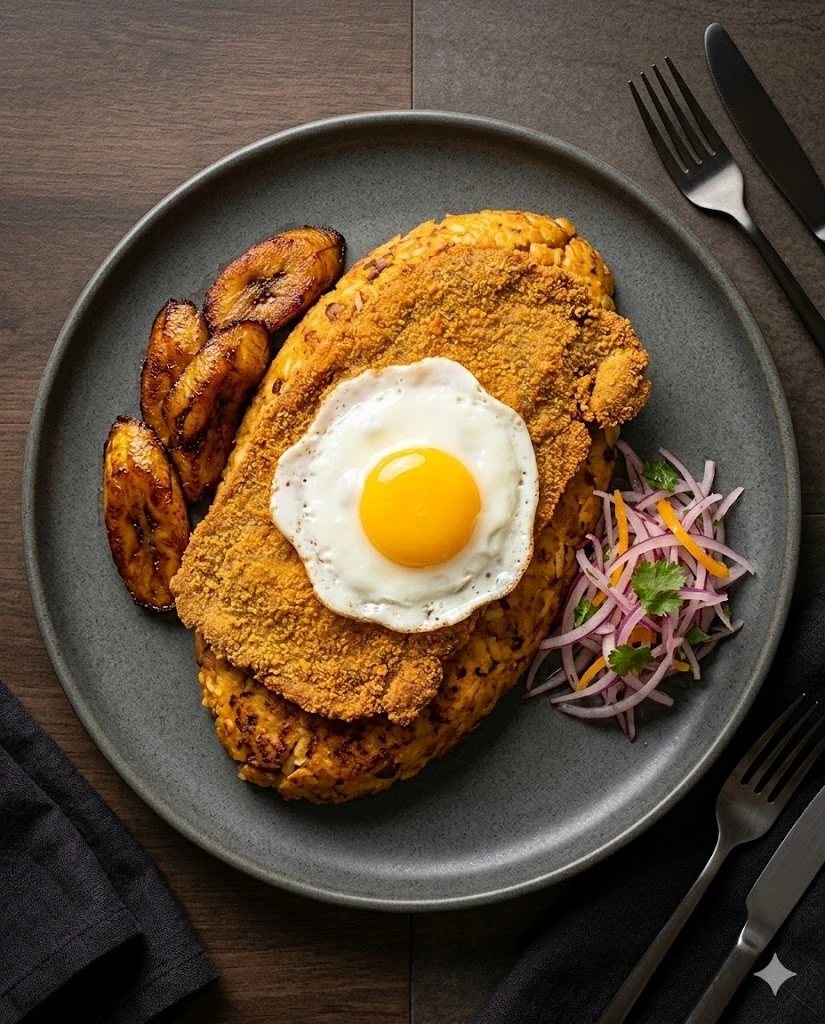
Two kinds of criollo browning on one plate. The tacu tacu keeps a creamy center beneath a firm crust while a thin, crisp sheet of breaded beef nearly covers it. The first cut breaks through both layers at once; after that, the plate practically takes care of itself.
Turn what you find into an experience you can actually bring to your kitchen.

Finely chop the red onion, garlic, and yellow chili. Heat part of the oil in a wide skillet and cook the onion for 4 minutes, until soft and lightly golden. Add the garlic, chili, cumin, some of the black pepper, and some of the salt; cook for 1 minute, until the seasoning smells cooked. Add the beans, mash roughly one third, then fold in the cooked white rice for 2 minutes, until moist and compactable while distinct grains remain visible.
Divide the mixture into 4 portions and shape compact ovals without pressing them excessively. Heat another portion of the oil over medium-high heat and brown two tacu tacus at a time for 4 minutes per side, leaving them undisturbed until a deep golden-brown crust forms and releases easily from the skillet. Flip with a wide spatula and finish the other side. Keep them warm without fully covering them; no resting time is needed.
While the tacu tacus brown, place the beef steaks between two clean surfaces and pound them to about 4 to 5 mm thick, broad and even without tearing the meat. Season with the remaining salt and black pepper. Coat first in the flour, then beaten egg, and finally the breadcrumbs, pressing only lightly to create a thin, even crust. Cook immediately; the breading does not need to rest.
Heat the remaining oil in a wide skillet over medium-high heat and fry the breaded steaks in batches for 2 to 3 minutes per side, until the coating is evenly golden and crisp and the meat is fully hot through the center. Transfer briefly to paper towels only long enough to remove surface oil, then serve immediately to preserve the crust.
Place one hot tacu tacu on each plate and lay one breaded beef sábana over it, allowing the steak to cover much of the base without adding the egg, plantain, or other garnishes associated with the a lo pobre version. The right result gives you two distinct crusts: toasted tacu tacu and thin breading, with a creamy rice-and-bean center underneath. Done! Cut straight through the middle and make sure each bite catches a little of both layers. 😌